Definitions
Stress is defined as force per unit cross-sectional area. Some common measurements of stress include Pa (pascal) and psi (pounds per square inch).  There are two types of stress: normal and shear. Normal stress includes tensile and compressive stress, because they act normal, or perpendicular, to the stress area. Tensile stress tends to stretch or lengthen the material, whereas compressive stress tends to compress or shorten the material. Shear stress acts in plane to the stress area and tends to shear the material. When you drag part two pieces of material stacked together, you are creating shear stress in between the two pieces of material.
Strain is the response or deformation due to stress, and it is defined as the change in length or angle relative to the original condition. In other words, strain is a ratio, making it unitless.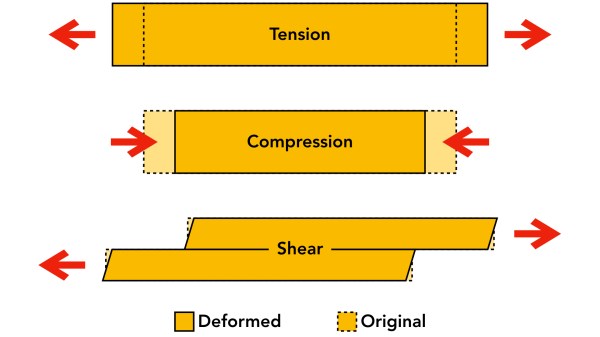 Likewise, there are two types of strain: normal and shear. Normal strain is the elongation or contraction (change in length) of a material caused by tensile or compressive stresses, respectively. Shear strain is the change in angle between two pieces of material caused by shear stresses.
Engineering vs. True
So far, we have only discussed engineering stress and strain, which assume a constant and undeformed cross-sectional area. For materials like metal, the dimensions change continuously under applied loading, and it would be inaccurate to base deformation characteristics on the original dimensions. To account for this, true stress and strain use instantaneous values for the area.
Young’s Modulus
Stress and strain can be related via Hooke’s law, which shows that within a so-called proportionality limit, stress is linearly proportional to strain. Therefore, doubling the stress doubles the strain, and vice versa. This relationship is true based on the assumptions of small strains and isotropy (material properties are independent of direction). Once a material is beyond the limit, the linear relationship is no longer valid. 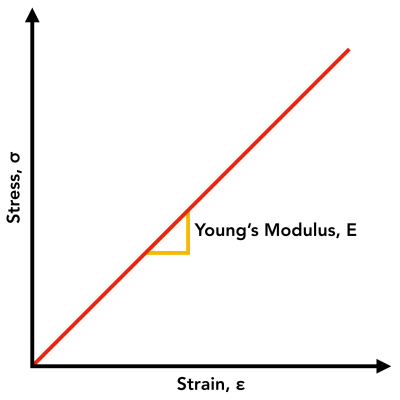 If we plot the linear, stress-strain relationship, we get a straight line with strain on the x-axis and stress on the y-axis. The slope of this line is stress over strain, or Young’s modulus (E). Because strain is unitless, Young’s modulus shares the same unit as stress (e.g. psi).
Young’s modulus is a material property, because each material has a unique Young’s modulus. Referring back to the plot above, what does it mean when a material shows a greater slope in its stress-strain relation (a greater E value) or vice versa? Well, given a greater slope, at the same strain value, there is a higher corresponding stress value. This means that a material requires more stress to reach the same amount of deformation. Therefore, a material with a higher Young’s modulus is considered stiffer than a material with a lower Young’s modulus.
Stress-Strain Curve
What happens when a material goes beyond its linear range under applied loading? Knowing that stress is no longer proportional to strain, the material experiences nonlinear behavior, and permanent deformation occurs. A typical stress-strain curve for a ferrous material looks like:
- From a to b, the stress is linearly proportional to strain. Therefore, the material yields elastically and can go back to its undeformed state.
- At b, the material reaches its proportionality limit. Stress is no longer proportional to strain, or σ ≠ Eε, after this point.
- At c, the material reaches its elastic limit. Stresses beyond this point cause permanent, or plastic, deformations.
- At d, the material reaches its yield point, where the curve levels off and nonlinear deformation begins. The subsequent horizontal region shows that stress is constant while strain increases.
- In the strain hardening region, stress increases again due to dislocation movements within the crystal structure of the material.
- At e, the material reaches its ultimate strength. Graphically, it represents the point of maximum nominal stress. After this point, the material experiences necking and deforms without added stress.
- At f, the material reaches its rupture strength and finally breaks.
Strain Energy, Toughness, & Resilience
When a material deforms, it stores strain energy (U). As an example, for a linear-elastic material, the strain energy is the product of the triangular area under the linear region multiplied by the material’s volume. Toughness is the absorbed strain energy before rupturing. Resilience is the absorbed strain energy up to the elastic limit. Proof resilience is the maximum absorbed strain energy up to the elastic limit. Both toughness and resilience can be calculated from the area under the stress-strain curve.
 StructNotes