Truss members can have zero internal forces depending on how the loads are applied on the truss. Therefore, identifying these zero force members and eliminating them can simplify truss analysis.
There are three main cases where zero force members exist.
Case 1: Pin-Pin
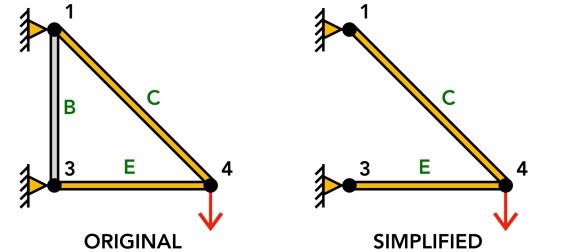
- When members are attached to pin supports AND no applied force is present on that member, then the member is a zero force member.
The pin supports restrain movement of member B and resist ALL the forces acting on members C and E. However, if the pin support at joint 3 becomes a roller, the “released” support reaction may have to be resisted by member B, which is no longer a zero force member.
Case 2: Two Member Joint

- When two non-parallel, members are connected at a joint AND no applied force or support reaction is present at that joint, then BOTH members are zero force members. (Joint 2, Members A and D)
- If there is a force or support reaction that is parallel to one of the two members, then the other non-parallel member is a zero force member. (Joint 5, Member G)
Recalling Case 1, member B is a zero force member as well.
Case 3: Three Member Joint
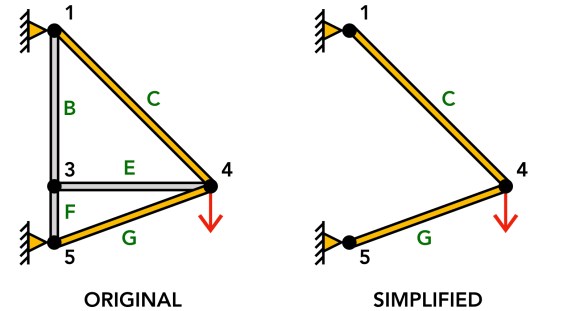
- When three members are connected at a joint where two of the members are parallel AND no applied force or support reaction is present at that joint, then the third non-parallel member is a zero force member. (Joint 3, Member E)
Recalling Case 1, members B and F are zero force members as well. Note that if the pin support at joint 5 becomes a roller, case 1 does NOT apply, and members B and F are NOT zero force members.
Example 1
Example 2

Example 3
 StructNotes