<< Back to Axial, Shear, & Moment Diagrams 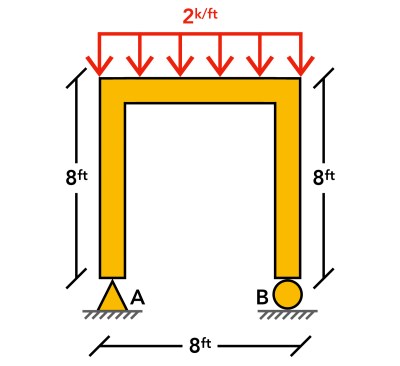 Step 1: Find the support reaction forces/moments.
We should always begin by drawing the free body diagram (FBD). Knowing all the externally applied forces and moments, we can determine the reactions at the support by summing the forces and moments. 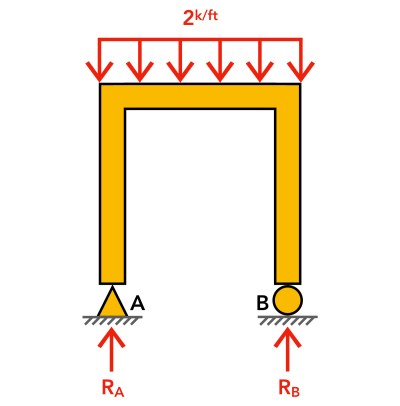 From the FBD, we know that there is even distributed loading across the length of the top frame member. Therefore, there are equal vertical, opposite reactions at the supports. To find these reactions, we can sum the forces and moments. For consistency, up forces and counterclockwise moments are positive.
  Note that the reactions are positive values, meaning that they are pointing upwards, according to our sign convention. They also match the direction of the arrows in our current FBD. However, if we selected the reaction forces to point downwards in the FBD, the values would become negative, meaning that the actual reaction forces are pointing upwards. Either way gives us the same results. Therefore, the main takeaway is that the positive and negative signs have to be consistent with the FBD and chosen sign convention.
Step 2: Determine axial/shear forces.
To determine the internal axial (A) and shear (V) forces, we are going to look at three segments. Generally, we can find the axial and shear forces along each segment by summing all forces.
By now, we should know that the assigned direction of A or V in the FBD should not matter. If their calculated values are negative, the forces actually go in the opposite direction, and we just made the wrong 50/50 guess. But, what do the directions of the forces mean? Do outward arrows correspond to tensile forces? Well, let us recall our positive sign convention for frames. 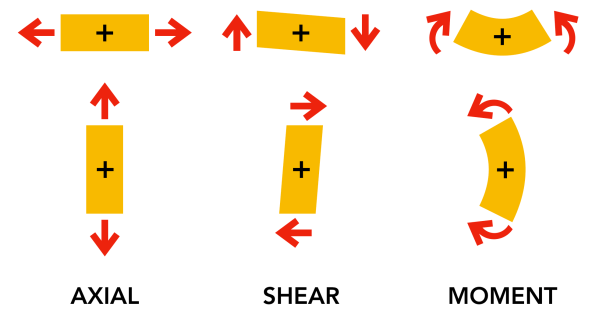 According to this sign convention, axial tensile forces are positive. This means that by default, the axial force (A) is drawn in the direction that creates tension on the segment in FBDs. Similarly, the shear force (V) is drawn in the positive direction as shown above.
Mathematically, we can say the force at distance x from the denoted origin in each segment is: 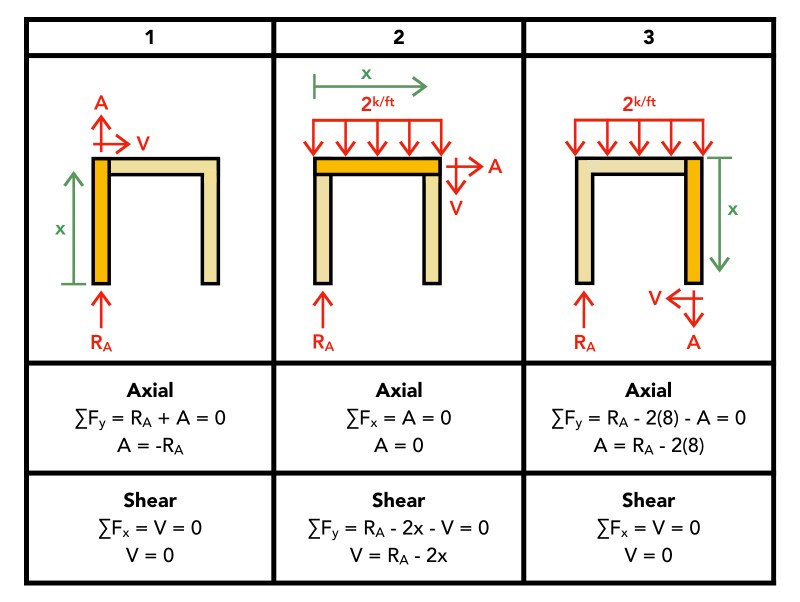 Since there is just one set of distributed load on this frame, notice the pattern; there is no shear force (V) where there is axial force (A), and there is no axial force (A) where there is shear force (V).
Step 3: Draw axial/shear force diagrams.
Once we have the force equations for each segment, we can plot the axial and shear force diagrams (AFD and SFD). Note that the axial force at the supports is equal to the corresponding reaction. Also, as stated in the list of basic rules, the AFD and SFD do not have to be continuous.  Step 4: Determine bending moment.
Similarly, to determine the bending moments (Mz), we are going to look at the same three segments. Generally, we can find the bending moment along each segment by summing all the moments. Mz is drawn in the positive direction in the FBDs.
Mathematically, we can say the bending moment at distance x from the denoted origin in each segment is: 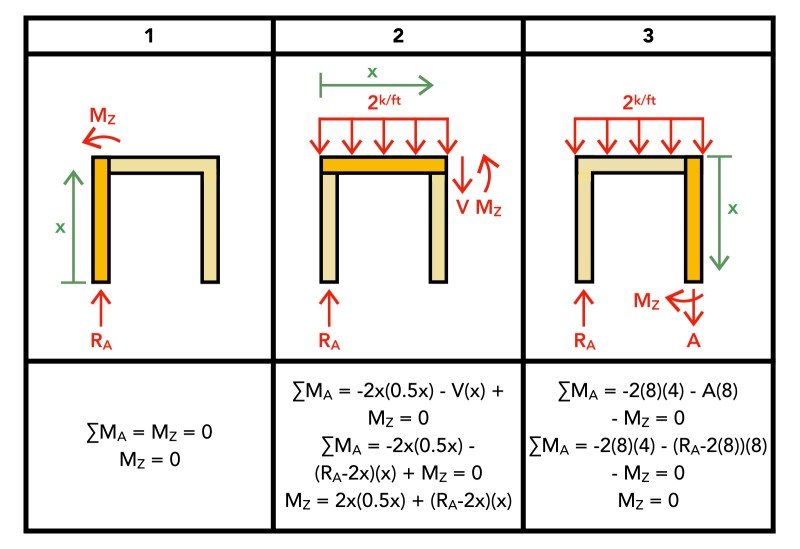 Step 5: Draw bending moment diagram.
Once we have the bending moment equation for each segment, we can plot the bending moment diagram (BMD). As stated in the list of basic rules, the BMD is continuous, even for frames. 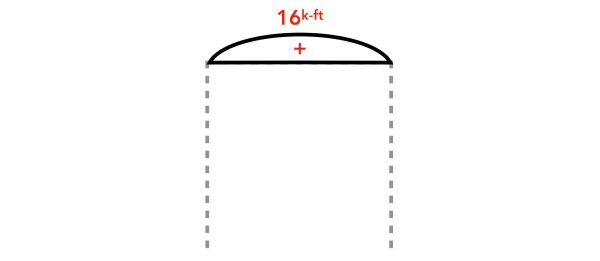 Recall that shear is the rate of change or derivative or slope of moment. Therefore, when shear force is zero, moment is constant. Also, we can determine the critical points in the BMD by finding the area under the SFD. In this case, the maximum moment in the horizontal segment of the frame is just the area of either triangles in the SFD, or (0.5)(8k)(4ft) = 16k-ft.
 StructNotes