<< Back to Axial, Shear, & Moment Diagrams 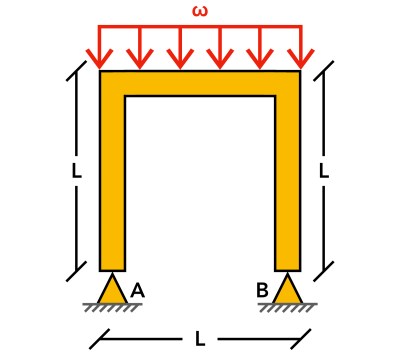 1. Support Reaction Forces/Moments
As stated in the problem statement, this frame is similar to the one in Example 6, except support B is now pinned and can no longer move horizontally. Naturally, the pinned support prevents the right column from flinging out, so there must be a horizontal reaction acting to the left at B. Since ∑Fx = 0, there must also be a horizontal reaction at A opposing the reaction at B. Knowing these horizontal reactions along with the vertical ones opposing the downward distributed load, the free body diagram (FBD) and deflected shape look like: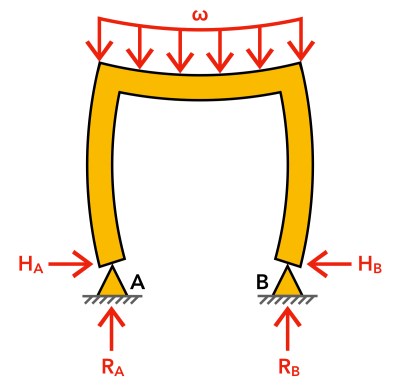 2. Shear Force and Bending Moment Diagrams
By now, we should be familiar with the general shapes of shear force and bending moment diagrams (SFD and BMD) under various static loading conditions. Here is a quick recap: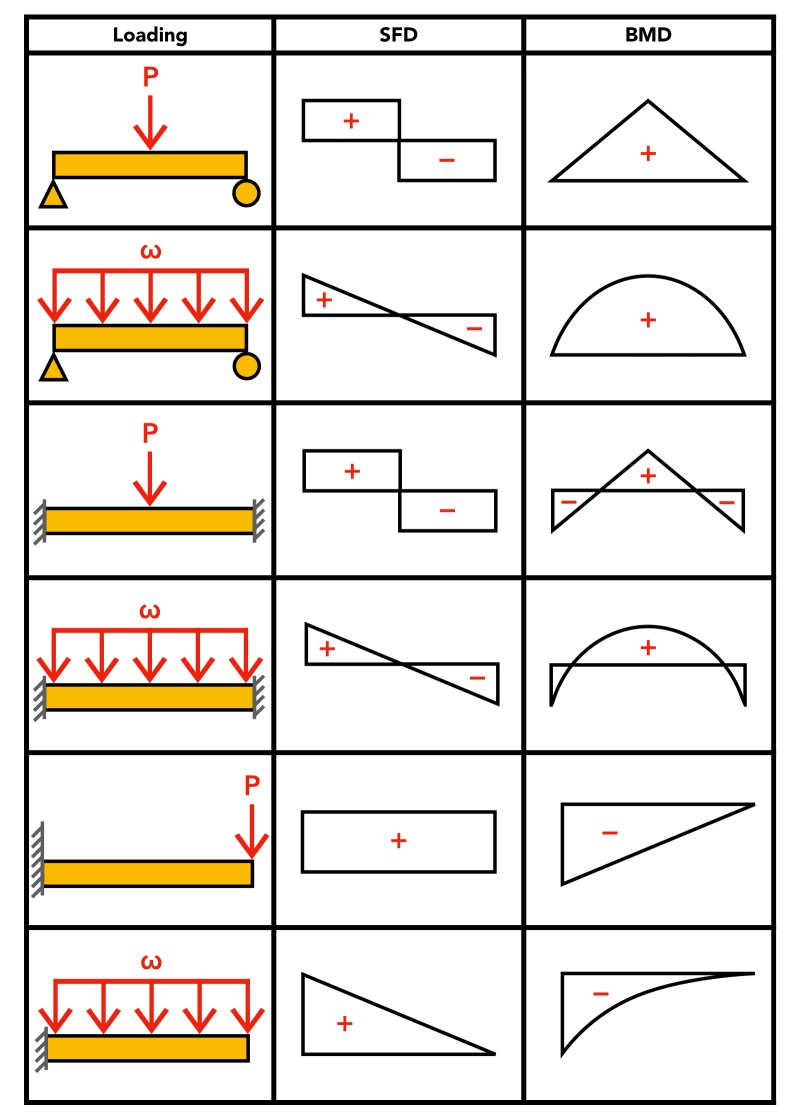 We can deconstruct the frame and see it as three separate members. This is possible, because the beam-to-column connections in the frame are assumed to be fixed. The diagram below shows just the distributed and shear forces from the FBD. These are the forces that contribute to the SFD and BMD.
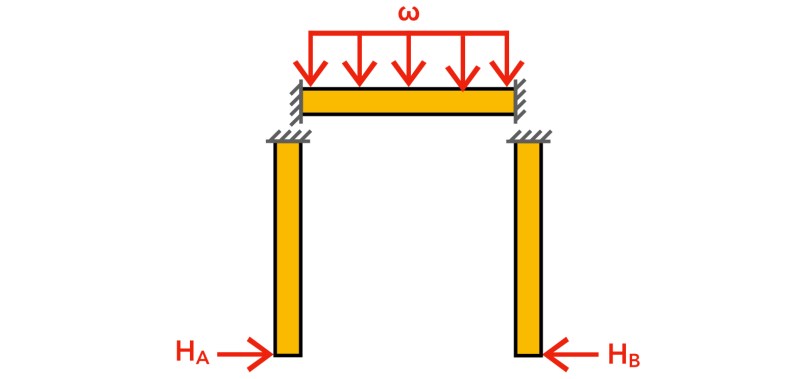 As a result, we now have three members whose SFDs and BMDs are familiar:
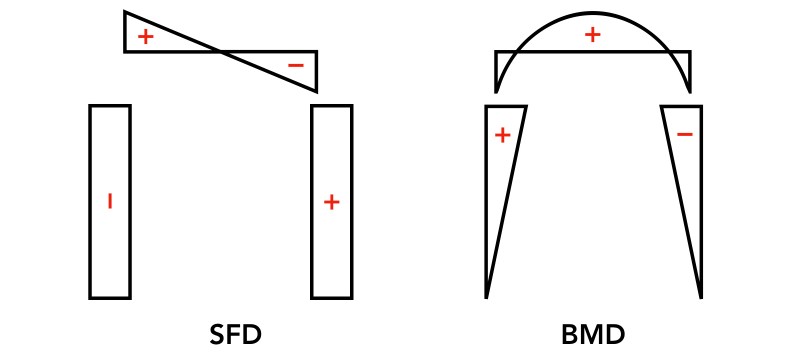 After making sure that the overall SFD follows a consistent sign convention, where, for instance, global left and up are positive, and that the final BMD is continuous, we now have:
  3. Axial Force Diagram
Likewise, to construct the axial force diagram (AFD), we can deconstruct the frame and look at it as three separate members. Here, we are going to just focus on the axial forces, which only exist on the columns. 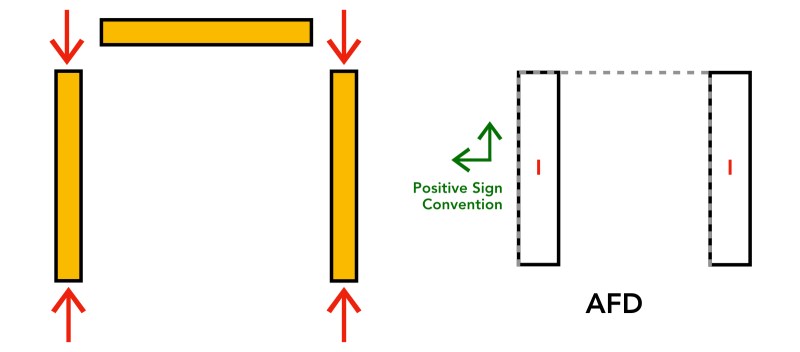 Recall that axial tensile forces are positive from our chosen sign convention. Because the columns are experiencing compressive forces, they are represented as negative values in the AFD.
4. Comparison
So, how are the diagrams different from the ones in Example 6, where support B is a roller? The AFDs are the same, because the vertical reaction at the supports, RA and RB, are the same in both cases. However, since the pin at B introduces horizontal reactions at the supports, the SFDs and BMDs are different. For comparison, here are the corresponding diagrams from Example 6: 
 StructNotes