<< Back to Axial, Shear, & Moment Diagrams 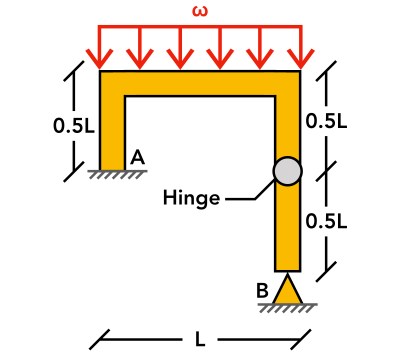 1. Support Reaction Forces/Moments
By inspection, support A must have a moment and vertical reaction, because it is fixed and opposes the downward distributed load. Will it also have shear force HA? It is not clear at this point yet, so to be safe, let us include it in the free body diagram (FBD). Next, is the hinge resisting any force? No, because if the hinge gets pushed downward, the bottom column will just tilt, pivoting at support B. Therefore, the hinge will move downward as well, and the downward push will have to be resisted by the support at B. Since the pinned support B pivots, providing zero shear resistance, by virtue of ∑Fx = 0, there must also be zero shear force at the hinge. Knowing all the reactions, the FBD and deflected shape look like: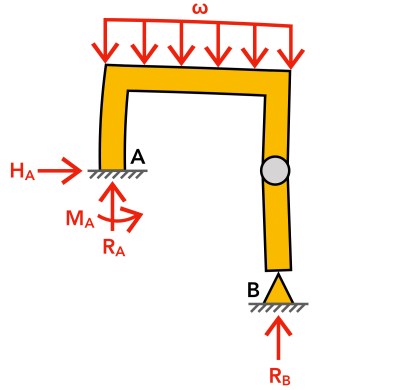 2. Shear Force and Bending Moment Diagrams
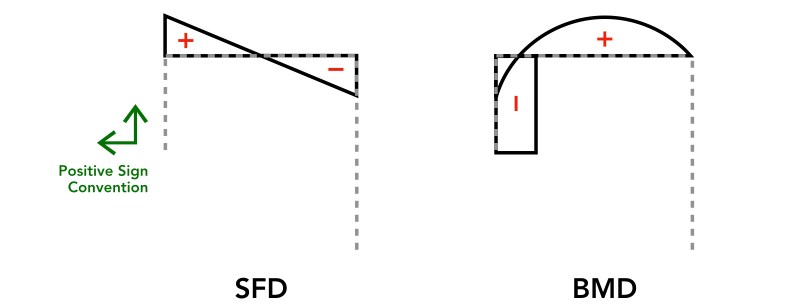
By now, we should be familiar with the general shapes of shear force and bending moment diagrams (SFD and BMD) under various static loading conditions. Here is a quick recap: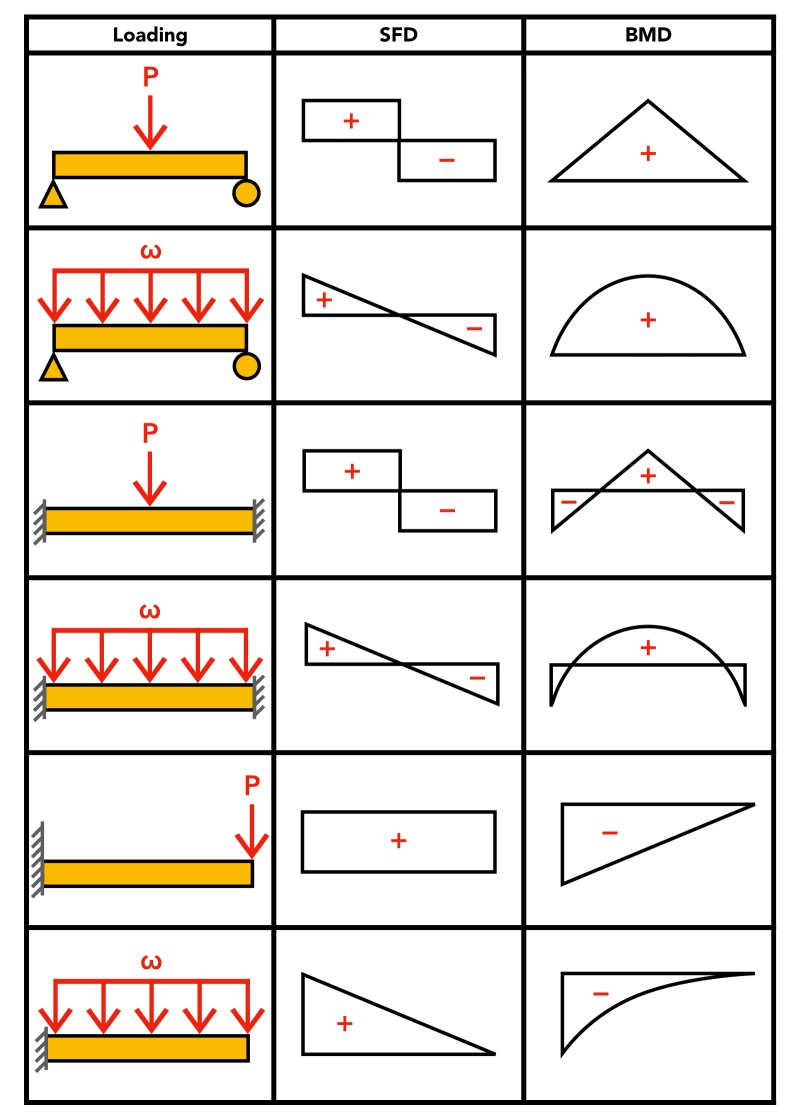 Let us first consider the BMD. We can deconstruct the frame and see it as four separate members. This is possible, because the beam-to-column connections in the frame are assumed to be fixed. As shown below, all the forces (except axial) are carried over from the FBD.
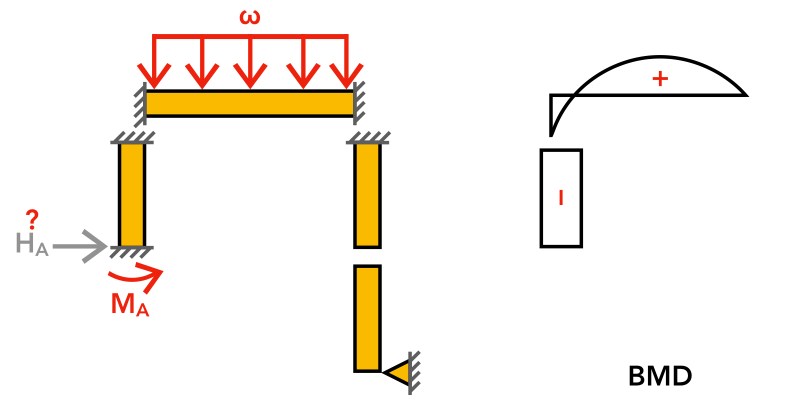 Notice the grayed-out force. Does it cause bending moment? There are two ways to answer this. First, from a global perspective in the FBD, there are no other lateral forces opposing HA. Since ∑Fx = 0, HA is 0 and causes no bending moment. Second, even if there is a nonzero force HA, it acts on a fixed support, causing no bending of the member, or no bending moment. Therefore, the only contributions to the BMD are the distributed load and MA at the fixed support.
Do you notice anything weird about that BMD, especially for the beam member? Yes, it is NOT symmetric! Since there is zero moment in the column and BMD has to be continuous, the right side of the BMD for the beam has to end at zero.
Now, let us consider the SFD. Likewise, we can deconstruct the frame and see it as four separate members. The forces (minus axial) are carried over from the FBD.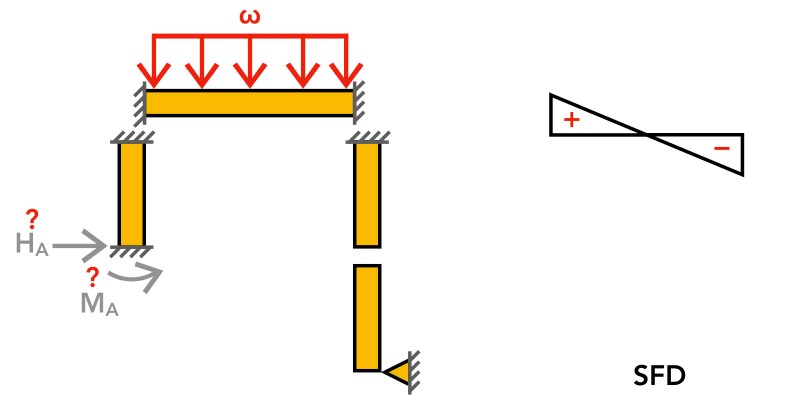 Notice the grayed-out forces. Do they create shear force on their members? HA is immediately resisted by the fixed support and does not add shear force in the left column, so no. A concentrated moment does not impact the magnitude of the SFD. As a result, the only contribution to the SFD is the distributed load.
Together, the SFD and BMD look like:
 3. Axial Force Diagram
To construct the axial force diagram (AFD), we can deconstruct the frame and look at it as four separate members. Here, we are going to just focus on the axial forces, which only exist on the columns. 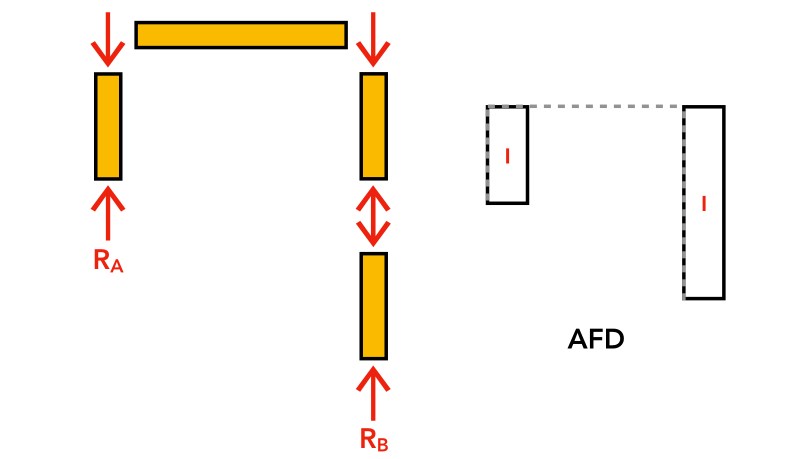 Recall that axial tensile forces are positive from our chosen sign convention. Because the columns are experiencing compressive forces, they are represented as negative values in the AFD.
 StructNotes