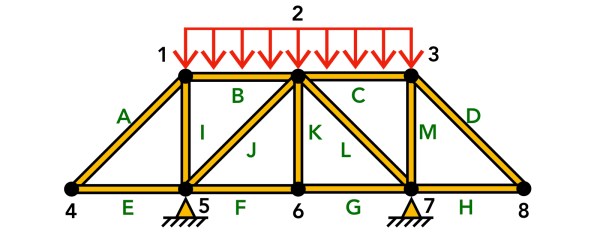
Case 1: Pin-Pin
The pin supports restrain movement of members F and G and resist ALL the forces acting on adjacent members. Therefore, members F and G are zero force members. (Without members F and G at joint 6, by inspection, member K is also a zero force member.)
Case 2: Two Member Joint
Joints 4 and 8 have two non-parallel members and no applied force or support reaction. Therefore, members A, E, D, and H are zero force members.
What about members I/B and C/M at joints 1 and 3, respectively? With the elimination of members A and D, both joints have two non-parallel members, where one of them is parallel to the direction of the distributed load. So, are members B and C zero force members?
No, and there are two ways to understand this. First, if we treat them as zero force members and eliminate them from the picture, the distributed load will be levitating in midair, which does not make sense! Second, using method of sections and summing the moment at joint 5 as shown below, there has to be a force in member B (and C, due to symmetry) in order to maintain static equilibrium. 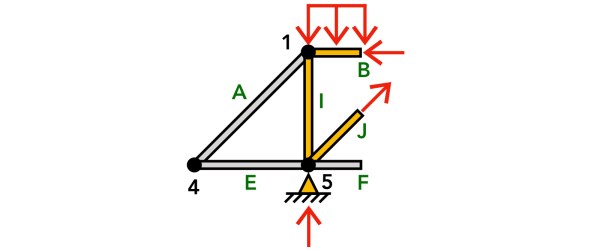
Case 3: Three Member Joint
Three members are connected at joint 6 , and two of the members, F and G, are parallel. Since no applied force or support reaction is present at this joint, this verifies that the third non-parallel member, K, is a zero force member.
Simplified Truss
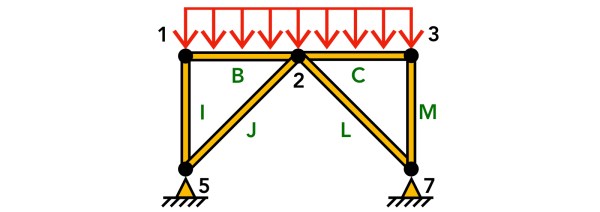
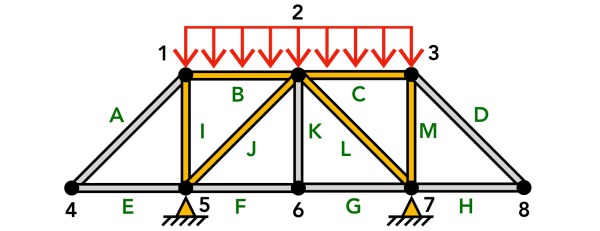 Knowing that the internal forces in members A, D, E, F, G, H, and K are zero, we can eliminate them from the picture to simplify truss analysis.
 << Back to Static Determinacy
 StructNotes