Axial, shear, and bending moment diagrams (AFD, SFD, and BMD) show the internal forces and moments along a structural member. They help determine the material, size, and type of a member given a set of loads it can support without structural failure.
Keeping a consistent sign convention is extremely important! We are going to define the positive sign convention as: 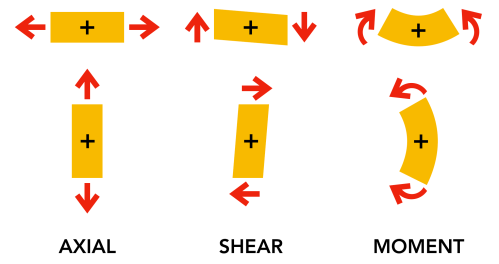 To be consistent with our convention, BMDs are drawn on the compression side of the member. As shown in the the figure below, this means that the compression side of the member represents positive bending moment.
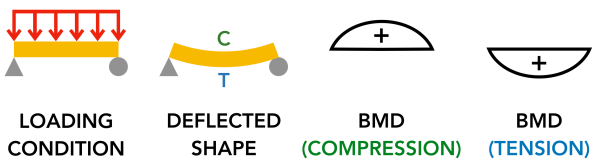 The best way to learn AFDs, SFDs, and BMDs is to practice drawing them with a few examples. But before we do that, we should understand the following basics:
- ΣForces = 0; ΣMoments = 0
- Moment = Force x Distance
- Shear = rate of change of moment (a.k.a derivative or slope of moment)
- If shear is zero, bending moment is constant (can also be zero).
- BMD is continuous. AFDs and SFDs may not be continuous.
- Fixed ends have moment reactions. Pinned/roller ends do NOT have moment reactions, but they can have externally applied moment.
- Trusses do NOT have shear force and bending moment diagrams. (Truss members only have axial forces: compression or tension.)
- There is zero bending moment at a hinge.
All AFDs, SFDs, and BMDs follow these basic rules. We will refer to them as we go through the following main steps in each example:
- Find the support reaction forces/moments.
- Determine axial/shear forces.
- Draw axial/shear force diagrams.
- Determine bending moment.
- Draw bending moment diagram.
Example 1
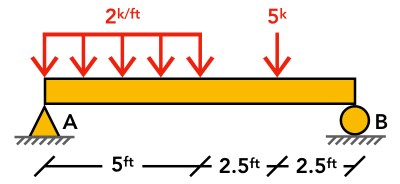
This is a beam with distributed and point loads. Before we begin, we should think about the following:
- What are the bending moments at the supports?
- What are the shapes of the AFD, SFD, and BMD?
Example 2
This is a similar beam to the one in Example 1, but there is now a hinge in the midspan. So, how does the hinge affect the force and moment diagrams?
Example 3
This is a similar beam to the one in Example 1, but there is now a cantilevered end with no additional forces. So, how does this affect the force and moment diagrams?
Example 4
This is a similar beam to the one in Example 3, but there is now a point load at the free end. So, how does this added point load affect the force and moment diagrams?
Example 5
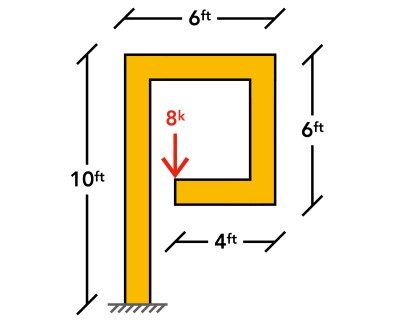
This is a frame with one support and a point load. Before we begin, we should think about the following:
- What are the shear forces in the vertical members?
- Where are the axial forces?
Example 6
This is a frame with distributed loading. Before we begin, we should think about the following:
- What are the bending moments in the columns?
- Where are the axial forces?
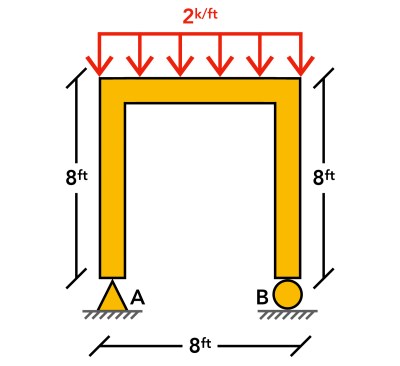
Example 7
This is a similar frame to the one in Example 6, except the right support is now pinned. Without performing any calculation, how does this one change affect the shapes of the AFD, SFD, and BMD?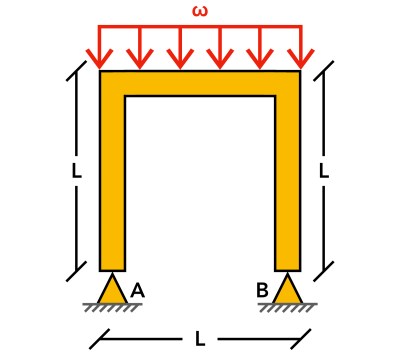
Example 8
This is a frame with fixed and pinned supports, in addition to a hinge in one of the columns. Without performing any calculation, what are the shapes of the AFD, SFD, and BMD?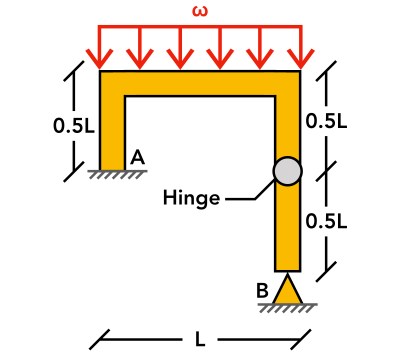
 StructNotes